Search

Stemma Genealogy

Ancestry Research

Tag

Family tree research uk

Family discoveries!

remembrance-day

George Charles Harris was born to Harry Harris and Alice Elcock in 1894 in Lockerley, Hampshire. He had an older brother William Sydney Harris, who had been born just the previous year.

The family lived in Carters Clay, near Sherfield English in Hampshire and like many families of the era and location, they worked the land. The 1911 census gives Harry’s occupation as a farm labourer and his two sons as woodmen. Within 3 years of this census, their lives were change considerably.

William married Maud Annie Ockley in October of 1914 and soon (the exact date cannot be determined) he enlisted in the army with the Hampshire regiment. His brother George followed in this footsteps and on 12th December 1915, he enlisted in Winchester for the Worchester Regiment. Both men would serve in France at various periods within their army career.

On 24th August 1916, while serving in Boulogne, George suffered a gunshot wound to the left of his chest, luckily missing his heart. He was sent home to Charring Cross hospital to recuperate.

Meanwhile, William had also been sent home for a brief period because in May of 1917, his wife gave birth to their daughter, Eleanor A M Harris. It is unclear if William ever saw his daughter because in March 1918, while serving with the 62nd Battalion Machine Gun Corps, possibly near Arras in France he was badly injured. He was to die of his wounds on 29th March 1918.

Four years after his death, Maud remarried and had another daughter. Despite this the family were to suffer another blow when Eleanor, (William’s daughter) died prematurely at the age of 30.


By 1917, George was now serving in the Army Veterinary Corps in Mesopotamia. By May however, he had contracted Malaria and was sent to a hospital in Bombay, India. It would seem that he contracted it again in March of 1919. He was eventually demobilised in January 1920 and later returned home to Carters Clay. It is unclear when he would have been made aware of his older brother’s death.

On his return home George became a spar maker (a carpenter who finishes and installs spars and masts on a boats and ships). He would meet his partner Alice Kate Alford of Whiteparish and they were engaged to be married in January of 1927. After surviving a gunshot wound and two bouts of Malaria it seemed that George had begun to make a life for himself.

On the afternoon of Sunday 19th December 1926, George collected his fiancé from Whiteparish on his Motorcycle and took her to his father’s home. He then left at approximately 3pm to travel to Awbridge to visit with Arthur Henry Loader (his sister-in-laws new husband) and stated that he would return shortly.

At around 3.30pm, a school master at Awbridge was called upon and made aware of an accident by a driver of a car. According to the driver – Arthur James Ledger Hill, he was driving his car down Romsey road, towards Awbridge when he noticed a man riding a motorcycle at some speed up ahead. Mr Hill pulled his car over to the verge fearing that there would be an accident. The motorbike could not make the corner and veered to the right of the road. The motorcycle struck the car and the driver was thrown to the verge.

A doctor was called and at 4.20pm, the motorcyclist was pronounced dead at the scene and it was determined that he had died instantaneously.

This motorcyclist was identified as George Charles Harris. He was 32.

At the age of 27, Alice was left alone – and pregnant!

It is unclear if George knew that his fiancé was pregnant with his child before he died, but the fact that they were soon to be married gives the impression that he may well have known.

Alice gave birth to a son on 22nd May 1927. She named him George Charles Harris Alford in recognition of her fiancé.

This man was my grandfather.


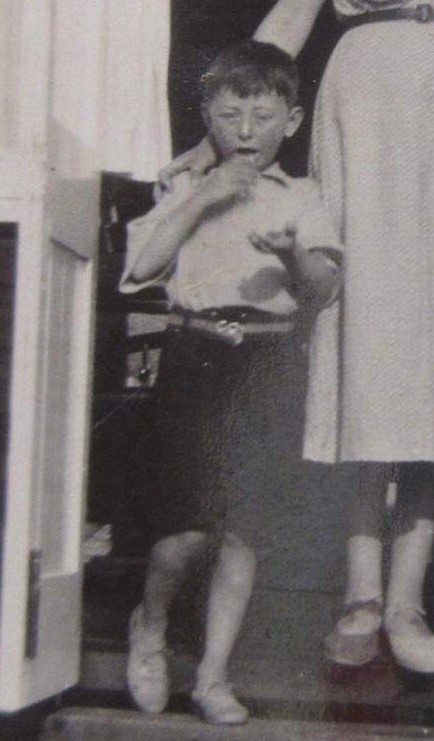
This is George Charles Harris Alford as a young boy and again on his wedding day at the age of 26.
The Murder of Little Emily

A few years ago while researching extended family members, I was told the sad story of Emily Mary Jarvis.

Known as ‘Little Emily’ to her family and named after her mother Emily Rainsdon, she was born in Bursledon in 1911 and was the youngest of three.

Her father, John Charles Jarvis, First Mate for a foreign-going steamship died suddenly in 1918 at Knowle Asylum after suffering an epileptic fit. Leaving his wife, then aged 37 and their children: John aged 12, Albert aged 10 and Emily aged 6.

The family eventually moved to Johannesburg – a warmer climate was believed to be better for the children’s health – and Mrs Jarvis eventually remarries.

In 1935, ‘Little Emily’ returns to the UK to undergo treatment to remove a brain tumour and travels to London to purchase a trousseau for her wedding dress as she was to be married the following month. While travelling to Southampton, Emily came into contact with a young Irishman by the name of John Joseph ‘Paddy’ Keyes, who was a writer in the purser’s department of the Union Castle liner Winchester Castle. The pair became friends and met regularly.

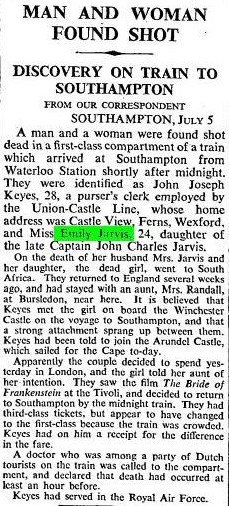
In the early hours of Friday 5th July,  the bodies of ‘Little Emily’ Jarvis and ‘Paddy’ Keyes were discovered in a first class carriage at Southampton Terminus Station.

Times, London, 6 July 1935

(Newspaper cutting – Times, London, 6 July 1935)

A guard, believing that the pair were asleep, opened the door to wake them only then to realise the full horror of the scene. The pair had suffered gunshot wounds to the chest (near the heart) and the pistol was found next to ‘Paddy’ Keyes

Some early newspaper reports suggest that the pair had decided on a suicide pact and that Emily wanted to remain in the UK,  however later reports suggest a more plausible alternative.

It would seem that ‘Paddy’ had fallen in love with Emily. Emily’s Aunt, Sarah Annie Randall states in The Evening News on Monday 8th July that “My niece had told me that Keyes loved her and had asked her to give up her fiance in Africa, but she had refused to do so”.

Hearing that she viewed their relationship as nothing more than friends,’Paddy’ decided that if he could not marry her then no-one else would. The jury returned the verdict that Mr Keyes had shot Miss Jarvis and then turned the gun on himself.

Emily Jarvis Burseldon

Emily was buried in her native village of Bursledon, Hampshire. Emily’s mother attended her funeral and her wreath bore a card that read “From her broken-hearted mother”. An additional large wreath was inscribed with “Sacred to the memory of my darling Em, from her sorrowing sweetheart, Ed, South Africa”.

Emily rests here in peace with other generations of this family.


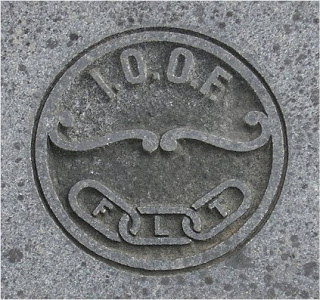
Gravestone Symbols – The Independent Order of Odd Fellows.

While researching a family line in America, I came across some interesting symbols on the gravestone of some of the deceased family members. I later learnt that these symbols relate to the Independent Order of Odd Fellows.

The Independent Order of Odd Fellows (I.O.O.F) originates in England in the late 17th century and started in America in the early 1800’s. It is believed by some to have been an offshoot of the Free Masons.

IOOD

IOOF are a religiously and politically independent fraternal order and similarly to the Masons, they have their own symbols and secrets. The Three linked chain is one of the most commonly seen and symbolizes their motto ‘Friendship, Love and Truth’. However unlike the Masons, women are accepted into the order.

Symbols for female members are often depicted with a moon and a dove. The Moon is a symbol of death, rebirth, or victory. A moon with seven stars, the letter “R”, and a dove symbolizes that the deceased was a member of the Daughters of Rebekah, an auxiliary of the I.O.O.F. fraternal organization.

The symbol to the left on the male gravestone is similar to the Ancient Arabic Order of the Nobles of the Mystic Shrine. Sometimes known as ‘Shriners’ they are members of the Masonic Order and adhere to the principles of Freemasonry Brotherly Love, Relief and Truth.

Shriner

Some of other symbols of the male gravestone indicates that he was a Veteran and members of the U.S American Legion.

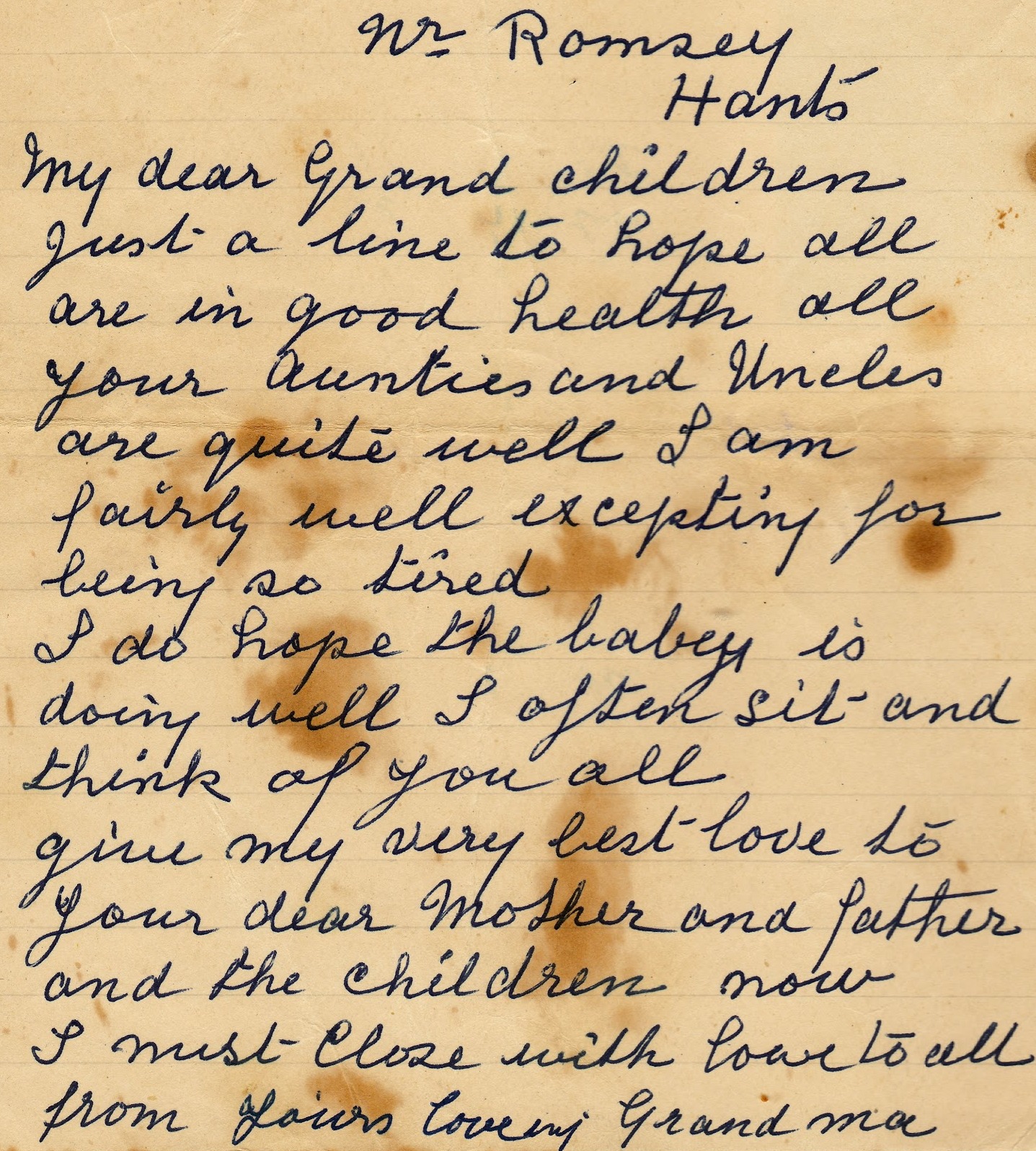
A letter to loved ones

Great Great Granda Snelgrove letter (Alice J L Longman)This is a copy of a letter from my great great grandma that was sent to family in Canada. Two of her son’s went to Canada after the first World War to work on their uncle’s farm. One of her son’s returned, while the other stayed in Canada and started a family of his own.

I find the line “I often sit and think of you all” particularly moving as she was never to see her son again. The long boat journey and the cost of travel made visiting very difficult but they kept in touch my writing and sending each other pictures.

Blog at WordPress.com.

Up ↑

Design a site like this with WordPress.com
Get started