Search

Stemma Genealogy

Ancestry Research

Tag

Stemma Genealogy

The Murder of Little Emily

A few years ago while researching extended family members, I was told the sad story of Emily Mary Jarvis.

Known as ‘Little Emily’ to her family and named after her mother Emily Rainsdon, she was born in Bursledon in 1911 and was the youngest of three.

Her father, John Charles Jarvis, First Mate for a foreign-going steamship died suddenly in 1918 at Knowle Asylum after suffering an epileptic fit. Leaving his wife, then aged 37 and their children: John aged 12, Albert aged 10 and Emily aged 6.

The family eventually moved to Johannesburg – a warmer climate was believed to be better for the children’s health – and Mrs Jarvis eventually remarries.

In 1935, ‘Little Emily’ returns to the UK to undergo treatment to remove a brain tumour and travels to London to purchase a trousseau for her wedding dress as she was to be married the following month. While travelling to Southampton, Emily came into contact with a young Irishman by the name of John Joseph ‘Paddy’ Keyes, who was a writer in the purser’s department of the Union Castle liner Winchester Castle. The pair became friends and met regularly.

In the early hours of Friday 5th July,  the bodies of ‘Little Emily’ Jarvis and ‘Paddy’ Keyes were discovered in a first class carriage at Southampton Terminus Station.
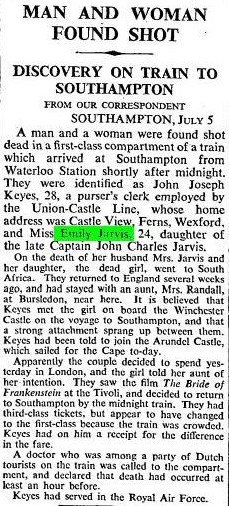
Times, London, 6 July 1935

(Newspaper cutting – Times, London, 6 July 1935)

A guard, believing that the pair were asleep, opened the door to wake them only then to realise the full horror of the scene. The pair had suffered gunshot wounds to the chest (near the heart) and the pistol was found next to ‘Paddy’ Keyes

Some early newspaper reports suggest that the pair had decided on a suicide pact and that Emily wanted to remain in the UK,  however later reports suggest a more plausible alternative.

It would seem that ‘Paddy’ had fallen in love with Emily. Emily’s Aunt, Sarah Annie Randall states in The Evening News on Monday 8th July that “My niece had told me that Keyes loved her and had asked her to give up her fiance in Africa, but she had refused to do so”.

Hearing that she viewed their relationship as nothing more than friends,’Paddy’ decided that if he could not marry her then no-one else would. The jury returned the verdict that Mr Keyes had shot Miss Jarvis and then turned the gun on himself.

Emily Jarvis Burseldon

Emily was buried in her native village of Bursledon, Hampshire. Emily’s mother attended her funeral and her wreath bore a card that read “From her broken-hearted mother”. An additional large wreath was inscribed with “Sacred to the memory of my darling Em, from her sorrowing sweetheart, Ed, South Africa”.

Emily rests here in peace with other generations of this family.


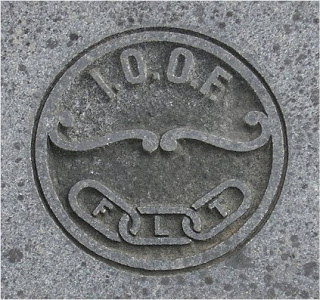
Gravestone Symbols – The Independent Order of Odd Fellows.

While researching a family line in America, I came across some interesting symbols on the gravestone of some of the deceased family members. I later learnt that these symbols relate to the Independent Order of Odd Fellows.

The Independent Order of Odd Fellows (I.O.O.F) originates in England in the late 17th century and started in America in the early 1800’s. It is believed by some to have been an offshoot of the Free Masons.

IOOD

IOOF are a religiously and politically independent fraternal order and similarly to the Masons, they have their own symbols and secrets. The Three linked chain is one of the most commonly seen and symbolizes their motto ‘Friendship, Love and Truth’. However unlike the Masons, women are accepted into the order.

Symbols for female members are often depicted with a moon and a dove. The Moon is a symbol of death, rebirth, or victory. A moon with seven stars, the letter “R”, and a dove symbolizes that the deceased was a member of the Daughters of Rebekah, an auxiliary of the I.O.O.F. fraternal organization.

The symbol to the left on the male gravestone is similar to the Ancient Arabic Order of the Nobles of the Mystic Shrine. Sometimes known as ‘Shriners’ they are members of the Masonic Order and adhere to the principles of Freemasonry Brotherly Love, Relief and Truth.

Shriner

Some of other symbols of the male gravestone indicates that he was a Veteran and members of the U.S American Legion.

Cleaning and conserving Latin Bible from 1580.

This Latin Bible from 1580 was once part of a library collection in a manor house in Hampshire. The house became derelict and was destroyed by fire in 1963 and some of the books where rescued by a neighbouring tenant on the estate.

After the death of this tenant in later years, this home was cleared of any belongings and this book, among a few others, were once again rescued – this time from a skip!

IMG_4602

This latest project is to examine the possible origins of the Bible and to discover if the original owner can be determined.

It is in good condition, with the exception of the deteriorating spine and some very light water marks. The inside back flyleaf of the book contains hand written details in Latin of family baptisms and the back of the book displays the coat of arms from the University of Cambridge.

IMG_4603 bible 1

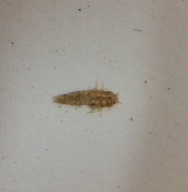
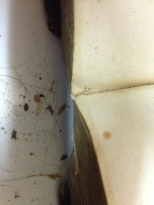
Before research the pages are lightly cleaned to removing any surface dirt and the gutter is brushed to clear any loose debris or insects.

IMG_4608 IMG_4616

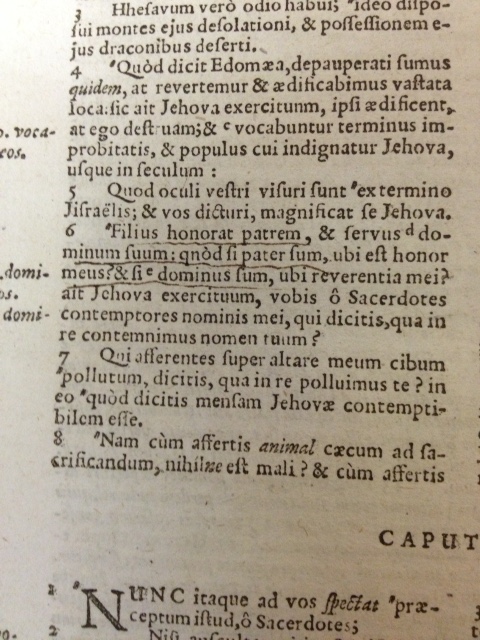
Then anything that may be relevant at a later date is photographed, for example, the notes written in Latin in the margins and parts of the text that have been underlined.

    IMG_4617    IMG_4606

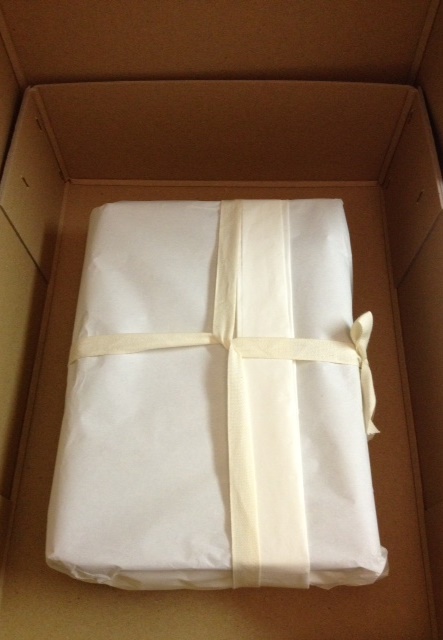
After cleaning and photographing, the Bible is wrapped in acid free tissue and placed into an archival box for future preservation. The photographs are then used for research instead of continually handling the book.

IMG_4619

Blog at WordPress.com.

Up ↑

Design a site like this with WordPress.com
Get started